Graceful Degradation: The Combination of Kinetic and AMP for Email
By Sean · August 9, 2026 · 6 min read
What if nearly every subscriber on your list could open an interactive email — one they can tap, rate, swipe, and respond to without ever leaving their inbox?
Not a lucky subset. Not "Gmail users only." Close to 90% of your audience, each getting the most functional version of your email their inbox can render.
That's not a future roadmap item. It's available today, using two technologies that were made for each other: AMP for Email and kinetic email. Individually, each covers a slice of the inbox landscape. Together, they cover almost all of it — and the strategy that ties them together is called graceful degradation.
Two technologies, two halves of the inbox
AMP for Email
AMP for Email is a framework created by Google that lets emails behave like lightweight apps. An AMP email can collect form submissions, update carousels, and even fetch real-time content at the moment of open — live pricing, current inventory, up-to-the-minute appointment slots.
AMP is its own coding language. It isn't standard HTML; it's Google's AMP framework, with its own components, its own validation rules, and its own approval process with mailbox providers. It's supported in Gmail and Yahoo Mail — which happen to be two of the largest inboxes in the world.
We're keeping the AMP overview high-level here on purpose. If you want the full picture — how AMP works under the hood, how to apply for sender approval, and which ESPs support it — we're covering all of that in a dedicated guide.
Read the full guide: Getting Started with AMP for Email.
Kinetic email
Kinetic email takes a completely different technical path to a similar destination. Instead of a separate framework, kinetic emails are built with standard HTML and CSS — using checkbox hacks, :checked selectors, and other advanced CSS techniques to create genuine interactivity inside the email itself.
A kinetic email can power tab navigation, image galleries, product reveals, surveys, star ratings, thumbs up/down feedback, and more. It can even collect data. It's more static than AMP — pure CSS can't fetch live content from a server — but for most campaign use cases, the experience is every bit as engaging.
Kinetic works where AMP doesn't: Apple Mail on iPhone, iPad, and Mac — the other half of the inbox landscape.
Different files, different languages
Here's the key thing to internalize: these are two separate files written in two different languages. An AMP file won't render as a kinetic email, and a kinetic HTML file isn't valid AMP. You can't convert one into the other with a find-and-replace. Supporting both means producing both.
That sounds like double the work. Hold that thought — it isn't.
The MIME package: how one email carries multiple files
If you've been in email marketing long enough, you already understand the core mechanic here, even if you've never thought about it this way.
For decades, marketers have sent an HTML file and a plain text file together in the same email. Remember building text versions for BlackBerry users? You weren't sending two emails — you were sending one email containing two files, and each recipient's inbox picked the right one.
That's because an email isn't a single file. It's a package — technically, a MIME type called multipart/alternative. The package holds multiple versions of the same message, ranked in order of preference, and the receiving email client picks the best one it can render (factoring in the user's own preferences — someone who's set their client to plain text will still get plain text).
AMP doesn't change this system. It just adds a third file to the package you already know:
- AMP for Email — served first, where supported (Gmail, Yahoo)
- HTML — the standard next-in-line for nearly everyone else
- Plain text — the safety net for legacy clients and text-preference users
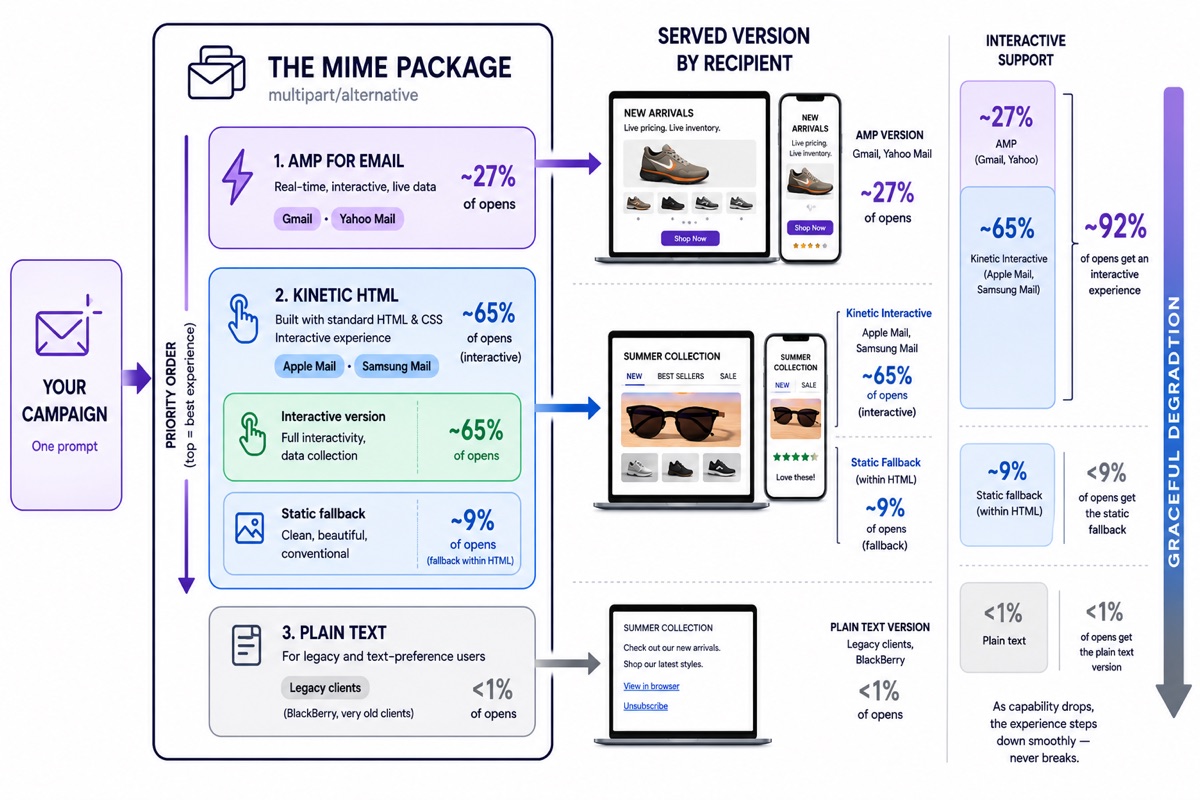
And here's where it gets good: when your HTML file is a kinetic HTML file, that middle layer is doing double duty. It contains the interactive kinetic experience and a built-in static fallback for clients that don't support the CSS techniques. So one send actually delivers four tiers of experience:
- AMP — fully interactive, live data (Gmail, Yahoo)
- Kinetic HTML — fully interactive (Apple Mail)
- Static fallback — clean, beautiful, conventional (Outlook, some Android clients)
- Plain text — for the last BlackBerry standing
Every subscriber gets the best email their client can handle. Nobody gets a broken one.
Graceful degradation is a strategy, not a compromise
"Degradation" sounds negative. Reframe it.
The old approach to interactive email was lowest common denominator: because Outlook can't handle interactivity, nobody gets interactivity. Design for the weakest client, ship the same static email to everyone, and leave engagement on the table for the 90% of your list that could have had more.
Graceful degradation flips that. You design for the best case and let the experience step down smoothly — never break, just simplify — as client capability drops:
- Gmail and Yahoo openers get the AMP version: interactive, data-collecting, capable of loading real-time content.
- Apple Mail openers get the kinetic version: interactive, dynamic, data-collecting.
- The remaining minority — mostly Outlook, some Android and off-the-shelf clients — get a polished static email that looks exactly like what everyone else saw, minus the interactivity.
Run the numbers on the latest Litmus Email Client Market Share data (May 2026): Apple Mail sits at roughly 65% of opens, Gmail at 24%, and Yahoo at 2.6%. Kinetic covers the Apple share; AMP covers Gmail and Yahoo. Combined, that's over 91% of opens getting an interactive experience. The static fallback serves the rest — led by Outlook at about 6.5%.
That's the graceful degradation promise: maximum experience for the many, a flawless baseline for the few, zero broken emails for anyone.
"But now I'm building two emails"
This is the objection that stops most teams, and it's fair. Two file types. Two coding languages. Two learning curves. Keeping the design, copy, and interactions consistent across both — by hand — is real work.
This is exactly the problem kinetic.email was built to solve.
Our generator creates both the kinetic HTML and the AMP version at the same time, from the same prompt. One brief in, two production-ready files out — with a consistent look, feel, and functionality across both, plus the static fallback already built into the kinetic file. The entire graceful degradation stack, generated in one shot.
You get the ~90% interactive reach without the double build.
The bottom line
Interactive email isn't blocked by technology anymore. AMP covers Gmail and Yahoo. Kinetic covers Apple Mail. The MIME package delivers each subscriber the right file automatically, exactly the way HTML and plain text have coexisted for decades.
The only thing that was missing was a practical way to produce both files without doubling your workload. Now that exists.
Design for the best inbox. Degrade gracefully for the rest. Reach everyone.
Ready to add AMP to your stack? Our full guide walks through sender registration, ESP setup, and sending your first AMP email: Getting Started with AMP for Email →